The decision layer for what autonomous systems are allowed to do.
A category-ready domain for the emerging control point that evaluates every consequential agent action before it executes.
The domain AgentActionDecision.com is for sale.
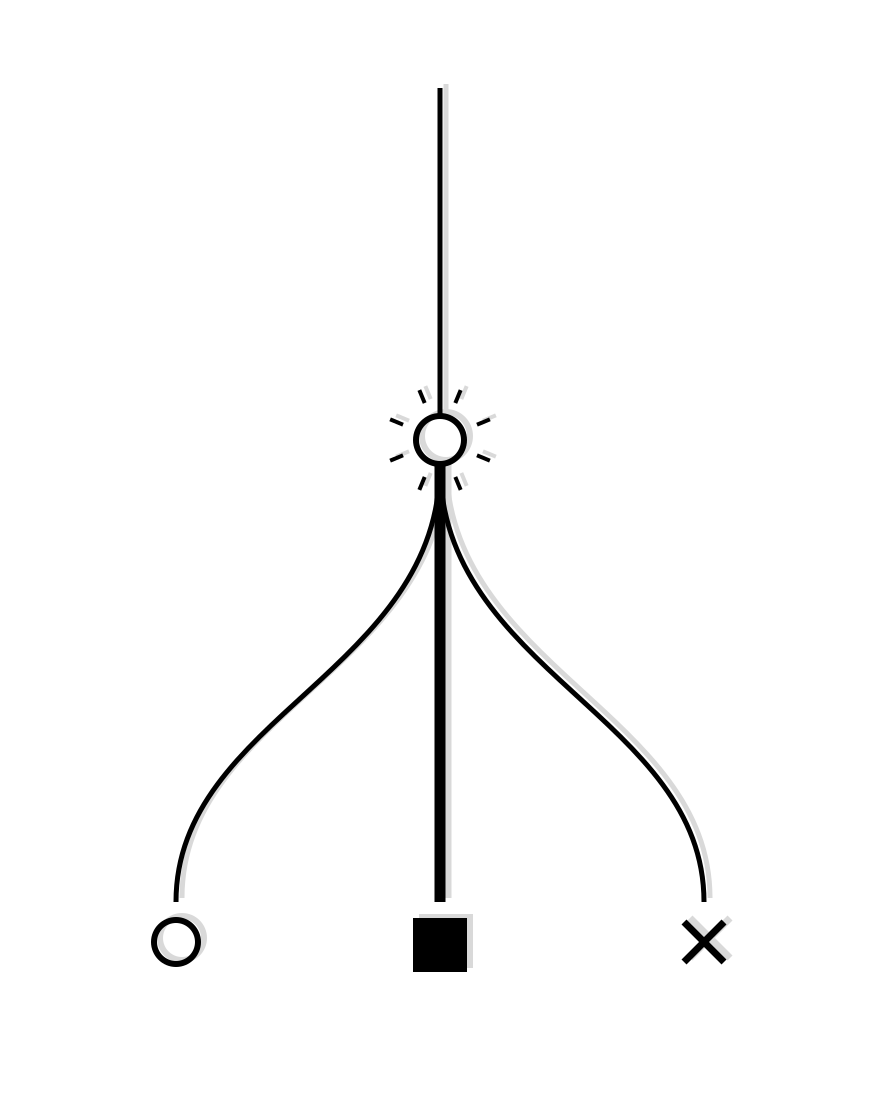
The thesis
Autonomous agents now hold credentials, call APIs, move money, and modify production systems. Each of those is an action with consequences, taken by software that reasons probabilistically. The question every serious deployment eventually asks is simple: who decided this action was allowed?
Traditional access control answers a different question. It decides what an identity may access in general, not whether this specific action, with these parameters, in this context, should proceed right now. Security architects have a name for the missing component. In classic policy architecture, it is the policy decision point. Applied to agents, the natural name for both the verdict and the layer that produces it is the agent action decision.
This terminology is emerging, not settled. That is exactly what makes the exact-match .com strategically interesting: the vocabulary is forming now, and the products that will define it are being built now.
Agents are gaining real authority. Agent frameworks and protocols such as MCP give models direct access to tools, data, and infrastructure. The blast radius of a wrong action grows with every integration.
Runtime enforcement is becoming the accepted answer. OWASP's guidance on excessive agency and its agentic-risk work both point to the same control: evaluate consequential actions at runtime, and require approval for the high-impact ones. Prompt-level guardrails are widely understood to be insufficient on their own.
Regulated industries need decision records. Banks, insurers, and healthcare companies cannot deploy agents that act without an auditable trail of what was permitted, by which policy, and why. A decision log is the artifact auditors will ask for.
Policy engines are looking for their agentic moment. Open Policy Agent, Cedar, and similar engines proved that policy-as-code works for microservices. Extending that model to agent actions is a short conceptual step and a large commercial opportunity.
Sources: OWASP LLM06: Excessive Agency · OASIS XACML 3.0 core specification · NIST SP 800-162: Guide to Attribute Based Access Control · Open Policy Agent · Cedar policy language · Before the Tool Call: Deterministic Pre-Action Authorization for Autonomous AI Agents (arXiv:2603.20953) · Authorization Propagation in Multi-Agent AI Systems (arXiv:2605.05440)
Who is likely to care: Security teams accountable for what agents do with production credentials; platform engineers building the gateways that mediate agent tool calls; compliance officers who must show regulators an approval trail; founders building authorization products for the agentic stack.
What could be built here
Plausible directions for the category, presented as opportunities rather than existing products. Any one could anchor a company; several could coexist as a product line.
- Runtime agent authorization engine
- A policy decision point purpose-built for agents: every tool call is evaluated against policy before it executes, with context the model cannot forge.
- Policy decision point for autonomous systems
- The PDP/PEP pattern, extended to agentic workloads. Policies written once, enforced at the gateway that mediates every agent action.
- AI action governance API
- A single API for a single question: may this agent take this action? It returns allow, deny, or escalate, with a signed decision record.
- Agent approval workflow platform
- Human-in-the-loop escalation for high-impact actions: durable pending states, approval on a channel the agent does not control, and evidence a resource server can verify.
- Enterprise agent kill-switch infrastructure
- Central revocation for running agents: suspend a class of actions, an individual agent, or an entire fleet the moment behavior drifts.
- Audit and compliance layer for agent actions
- An append-only record of every decision: the action requested, the policy consulted, the verdict, and the approver. Ready for incident review and regulatory examination.
Where the decision sits
One evaluation point between intent and execution. Every verdict is logged.
Agent
holds credentials, plans a task
Requested action
tool call, API request, transaction
Policy evaluation
identity, parameters, context, risk
Action decision
signed, logged, attributable
- Allow
- Deny
- Escalate to human
Why this name
The name is the API. Agent, action, decision. Three words in the order the system evaluates them. A developer who hears the name once can guess what the product does, which is rare and worth paying for.
Exact-match with the security literature. Decision is the term of art. Policy engines emit decisions; XACML formalized the policy decision point two decades ago. This domain inherits that vocabulary instead of fighting it.
Category ownership before the category consolidates. Agent authorization is being built right now by startups, cloud providers, and identity vendors. None of them yet owns the plain-language name for the thing they all sell.
.com credibility for a security product. Security buyers are conservative. An exact-term .com signals permanence in a way that clever misspellings and exotic TLDs do not.
Extensible brand surface. The name supports a product, a protocol, an open-source engine, or a conference track without strain. It also shortens naturally: decisions, decision log, decision API.
Who it fits
Buyer classes, not named companies. If your team fits one of these descriptions, the inquiry form below reaches the decision-maker directly.
AI infrastructure startups
Teams building the authorization, gateway, or governance layer of the agentic stack, for whom this name is the category.
Identity and access management vendors
Established IAM companies extending from human and workload identity into agent authorization.
Enterprise AI governance platforms
Vendors selling policy, audit, and oversight to regulated enterprises deploying agents.
Cybersecurity companies
Security platforms adding runtime control of agent behavior to existing detection and response portfolios.
Venture-backed stealth teams
Funded founders who need the definitive name before launch, when naming is cheapest to fix.
Reading
What is an agent action decision?
An explainer on agent action decisions: runtime authorization verdicts for AI agent actions, how they relate to policy decision points, and why the pattern is emerging now.
Why API keys and RBAC are not enough for AI agents
Scopes were designed for deterministic callers. An agent holding a valid credential can be talked into misusing it, which is why authorization for agents moves from the credential to the action.
Buying it
No price is listed. A credible intended use, and an indicative range if you have one, move the conversation fastest.
How a sale works
- Transfer via a reputable escrow service or registrar-mediated process. Funds release only on confirmed transfer.
- Confidential discussions welcome; a mutual NDA is available before substance.
- The sale conveys the domain registration. Trademark clearance for your use is yours to run, as with any name.
Questions
Yes. AgentActionDecision.com is available for acquisition by a party that intends to build in or adjacent to this space.
No. This site presents the strategic case for the domain name itself. No product or service is currently offered under this name.
The sale covers the domain name registration only, unless otherwise agreed in writing. No trademark rights are claimed or conveyed, and buyers should conduct their own trademark clearance for their intended use.
Through a reputable escrow service or registrar-mediated transfer. Funds are held in escrow, the domain is transferred to your registrar account, and funds are released on confirmation. Typical timeline is a few business days.
Yes. Inquiries are treated as confidential by default, and we are glad to sign a mutual NDA before substantive discussions.
No fixed price is listed. Serious inquiries with an indicative range receive a prompt response; the range field on the form is optional but speeds things up.